Wednesday, August 23, 2017

#RPGaDay: Day 23


Here we are at Day 23 (Hail Eris). It's a solid question today, one that I took in a direction you might not expect...

Which RPG has the most jaw-dropping layout?

Answer: Palladium Books. The whole line, at least up until the mid-2000s.

Those of you who have any of the old Palladium books books prior to 2005 will notice that the layout there in was a bit...odd. I could never put my finger on why it bothered me so much; the layout was incredibly simplistic, artwork was reprinted regularly and in a way that hinted the image was a copy of a copy. I didn't really now why until several years ago when I read a recount and criticism by Bill Coffin on Kevin Siembeda's design practices.  Bill's recount is rather colorful and laced with snark, but it did give me insight as to why I was bothered by it all.

Once Kevin's ready for layout, he prints out the whole mess and fires up his wax machine because he still puts these damned things together by hand. What's that? Desktop publishing software? Naw, he's faster without it! To his credit, he lays out the book in fairly decent time, but he also illustrates why all Palladium books have a simple two-column format. Kevin isn't going to cut columns to shape or deviate from formula because he might have to reflow a section of the book, and when he does, all those columns have to be standard or else none of it works. Where this really makes you want to bang your head against the tip of an artillery shell is when he lays out 80% of the book, discovers that he'd like to rename an alphabetically ordered item on page 5 and decides that it would be too much work to reflow the rest of the list. You know how every so often in a Palladium book you'll have a series of NPCs or OCCs or something and one of them is grossly out of alphabetical order? That's why. I used to think it was because Kevin couldn't read the alphabet. Now I know it's because he's truly, madly, deeply in love with putting books together in ways that even Monty Burns would decry as old-fashioned.
Now, admittedly a few years after this post hit RPG.net, Bill issued a public apology to Kevin and they seemed to have buried the hatchet. But still, if that was what was going on with Palladium back in 2003, it certainly explains a lot of the issues I had with the layout of the various books from that company. This post always stuck with me, and every time I crack own a product from Palladium, even a modern one, I have to wonder if it was laid out by hand on a light table.

Tomorrow's question is going to be tough...probably because I don't think I've ever used a game from a Pay What You Want publisher.

Tuesday, August 22, 2017

#RPGaDay - Day 22


Now that we're caught back up, let's keep this train a rolling.

Which RPGs are the easiest for you to run?

Any RPG I'm incredibly familiar with that doesn't force me to reference a massive amount of charts to run. I really enjoy running FFG's Star Wars RPG because generally speaking I only have to look up Critical Injury results when someone scores a critical hit. Otherwise I generally don't have to look up most of the tables. I know by extensive practice what you can do with 3 Advantage, or 2 Threat. I know how much damage a blaster pistol does, or that a Vibro-Axe has the Vicious 3 quality. FFG even makes NPC management easier with their Adversary Deck. I've now got over a hundred adversaries on playing cards that I can dig through and slap onto the table as needed. The game system is so flexible that at a glance I can even add abilities and effects to the base card stats and my PCs are none the wiser.  I theoretically COULD just sit down at a table with no prep-time or pre-made adventure and ask my players "okay, what do you do?", and generally speaking I could make up the adventure on-the-fly.

The harder RPGs to run are those that require a lot of chart-reference. Earthdawn comes to mind, as that game as a "Step" system that determines how many dice you roll. I got a lot of practice with that, but it's a lot harder to remember what you roll for Step 16, or Step 21, or 32. If a lot of bookkeeping is needed to play, that's a lot harder to keep up with while trying to keep the game going. Critters with massive amounts of hit points with a novel-length list of abilities can be very daunting to try and keep track of while you're trying to keep the action dynamic and exciting. You can totally kill your momentum by having to pause for 30 seconds while you figure out what a dragon or a beholder is going to do next.


I have a hunch tomorrow's question is going to be fun to write, and not in the way many folks are expecting. I anticipate that two or three of my friends will read it and have reactions like "...they WHAT?!"

Stay tuned!

#RPGaDay: Day 19, 20, 21


Aright; one more trio and then I'm caught up to today...

19: Which RPG features the best writing?

Star Wars.

Signed by Bill Slavicsek, Sam
Stewart, Sterling Hershey,
and Pablo Hidalgo
Okay, before you all start rolling your eyes, I'm going to clarify that statement; West End Game's original D6 based Star Wars RPG. It had a lot going for it. First of all, as I learned again while watching the "30 Years of Star Wars RPGs" panel at GenCon this year, a lot of what the WEG Star Wars game did was fill in a lot of gaps in the movies from an information standpoint. Until the RPG came along, there were no twi'leks, rodians, or ithorians. No one knew Sienar Fleet Systems made the TIEs, or Koensayr the Y-Wings, or INCOM the X-Wings and Snowspeeders. The name "Kuat Drive Yards" meant nothing, and didn't immediately bring to mind giant 2 kilometer long, triangle shaped warships. The RPG team and the developers on it created terms and ideas that are now used in Star Wars writing today. The gaming books that were written were designed from the standpoint of "we're the only ones making anything Star Wars right now, let's make it good." Sourcebooks such as Cracken's Rebel Field Guide and the Imperial Sourcebook are resource goldmines for every game and camapign that came after it. Out of the WEG Star Wars line came original work by folks like Pablo Hidalgo, Timothy Zahn, and Michael Stackpole.

Suffice to say that the Star Wars we know today would not have been possible without the work of Bill Slavicsek and his writing team at West End Games. One of the highlights of my week at GenCon was listening in on his panel and hearing the stories about the early days of Star Wars gaming. Shaking his hand afterwards and giving him an enthusiastic "thank you!" was a bonus.


20: What is the best source for out of print RPGs.

If you don't mind them being PDF copies, I have to direct folks to DriveThru-RPG. They've got quite a few games that have given up the ghost and faded into almost-obscurity. I'm sorely tempted to pick up a pdf copy of Mekton Zeta and Mekton Zeta Plus, just to have them on my tablet.

Which reminds me that I should really get a new micro-usb for my tablet. My 32GB one is starting to reach capacity...


21: Which RPG does the most with the least words?

I'm going to have to go with Lasers and Feelings. You can't get better than a one-page RPG that basically does it all for playing a "Not Quite Star Trek" game.

Speaking from a traditional published-work perspective, I'll probably look to Savage Worlds and FATE Accelerated. These two books are tight, digest-sized RPGs that can handle just about any genre or game as-is. Sure, there are expansion books that flesh out a lot of the details and give players expanded rules, but you really don't need them if you want to play a steampunk game, or a sci-fi game, or a fantasy game. All the rules you need are in those books, and the rest you can build off of them.


And with that, we're caught up to today. Tune in later this afternoon, when I answer the Day 22 question "Which RPGs are the easiest for you to run"!

Monday, August 21, 2017

#RPGaDay: Day 16, 17, 18


Still in the airport in Indianapolis, still trying to get caught up on this exercise. 

Day 16: Which RPG do you enjoy using as is?

No plan survives contact with the enemy, and there is extensive evidence to support that no RPG survives contact with the gaming public. Gamers across the internet are constantly posting changes they've made to make their well-loved games "better". I'm guilty of it too; I've made some self-determined "fixes" to my beloved Star Wars RPG. When recovering strain at the end of encounters, I allow 2 Advantage to heal 1 strain. In space combat, I allow pilots to take a "Snap Roll" reaction to reduce the damage from a successful hit by the pilot's Ranks in the Piloting skill plus the Handling of the vehicle. I had a bevy of house rules for previous editions of the game, and for most games I've run in the past 10 years.

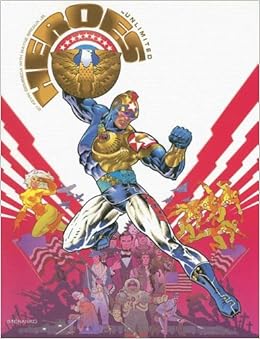
But the one RPG that I didn't really make any changes to (at least that I can recall) may surprise some of you; Heroes Unlimited. Yup, a Palladium Books game with their broken system and all; I ran a campaign in that system relatively straight out of the rulebook. The rules in HU weren't as broken or over-the-top as RIFTS, so it didn't break down with excessive amounts of attacks and die rolls for combat. My players and I got a good 2 years out of that system and that campaign, and we did it without any changes to the rules presented as written.

Day 17: Which RPG have you owned the longest but not played?

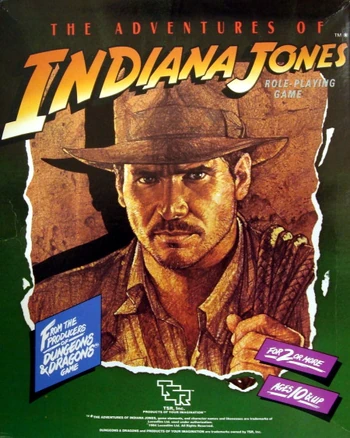
You know, at first I thought this was going to be a tough question and then I remembered something I inherited from my grandmother when she passed away in 2004. My grandma, known in Sci-Fi circles as "Grandma Trek", would often receive books, magazines, and other periodicals from publishers. One item she received was the universally panned The Adventures of Indiana Jones Role Playing Game. The game is just...awful; so awful that TSR's celebration of the license lapsing and their ability/obligation to burn every remaining copy led to the creation of the "Diana Jones award for excellence in gaming." 

Every other game I owned that have never thrown down on the table has been given away or sold, so by default the Indiana Jones RPG wins.


Day 18: Which RPG have you played the most of in your life?

That's a really tough call. It really comes down to what the limit is.

If we're sticking with one system and one edition, it's probably going to be Dungeons and Dragons 3rd Edition (and I'll include 3.5 Edition in that). I ran many a game and many a campaign for a solid 8-10 years using that system. I don't think I was able to run any specific edition of Star Wars for that long.

However, if you're opening up the definition to all editions of the game, then it's Star Wars hands down. I attended a panel on Saturday at GenCon that talked about the 30th anniversary of the Star Wars RPG license, and I've been gaming in that system since West End Game's 2nd edition of the rules. That's at least 25 years of gaming in the Star Wars galaxy.

No wonder I'm such a Star Wars nerd.


#RPGaDay: Day 12, 13, 14


Currently sitting in the Indianapolis airport, waiting to catch my flight home from GenCon. Since I've got two hours before my flight, I figure now is a good time to finish this off...

Day 12: Which RPG has the most inspiring interior art?

Unsuprisingly, I'm going to go with the Star Wars RPG from Fantasy Flight Games. Their art design is par none, with each book in their line containing not only beautiful two-page chapter-headers and gorgeous career portraits, but also include a wide array of original art pieces that evoke stories. The young twi'lek girl who finds a holocron in an antique shop, the rebel soldier in a trench looking at the holo of her dead loved one, the aspiring Jedi fighting an Inquisitor on the exterior of a Star Destroyer in an asteroid field; these pieces capture the mystery, the conflict, and the excitement of gaming in the Star Wars galaxy.


Day 13: Describe a game experience that changed how you play.

This is a tough one. Most of my current gaming style comes from decades of evolution in my Gamemastering style. It's rather difficult for me to look back over that time to try and remember one event that changed how I run games, but I can call back and find something that affected my gaming; conventions.

My first foray into convention games was at Origins back in 2005 (I think). My brothers and I were into Mechwarrior: Dark Age at from time to time we'd go to Origins to compete in the National Championships. Wizards of the Coast was in the final year of their Living Force campaign, and I wanted to finally get a chance to play in a Star Wars game instead of running them all the time. I remember my Kel Dor Jedi fondly, and I also remember the aggravation of having to deal with "convention gamers"; guys who's RP style was to dick around and act in manners that no actual person would (at least, not without being arrested). I was there to try and get a positive gaming experience from the other side of the GM screen, meanwhile Dicky the Wonder Smuggler from Central Who-gives-a-damn just wanted to be a wise ass for the sake of being a wise ass. Thankfully, the sessions weren't a total wash, and I did have fun in the end, but it definitely made me appreciate the players that I get to play with from my meticulously cultivated player-group at home. Additionally, it reminded me that not everyone in the world games like I do, and when I run convention modules I try and have the patience and composure to let the players enjoy the game in their own way, and to only interject when someone is monopolizing the game for their own enjoyment at the expense of someone else at the table.

Day 14: Which RPG do you prefer for an open ended campaign?

Any RPG that lacks a finite progression path.

There's something about a game with a set number of levels to character progression that puts a timer or a cap on a game. D20 system's traditional "20 Character Levels" is a great example. Especially in the sense of Star Wars Saga Edition, D20 characters tended to have their progression mapped out; most of my players would build their entire character paths out from the start of game.

"Okay, I know I want to take Jedi Knight at  7th level, and I want to have these powers by Level 9, so I need to take Feat X and Y at 6th Level, Talent Q at 5th and R at 8th, and Knowledge: How to be a Bad Ass Jedi when I increase my Intelligence at 8th level..."

That sort of character road-mapping really put a dampener on letting your character naturally grow and evolve. Life is full of events and crossroads where your intended career and lifepath deviates greatly from where you expected to go. I've come to really enjoy games where the system encourages that sort of freedom.

Additionally, the D20 system also starts to get bloated and a real challenge to run once characters get over level 11 or 12. The threats have to scale up, which usually meant more time spent on npc development as well as management of an excessive number of abilities in each character. More often than not, I'd forget to utilize those abilities simply because my mental bandwidth couldn't handle trying to remember and control six NPCs able to challenge a group of six Level 12 PCs. That encouraged me to end campaigns as they reached that level, before I really got bogged down, which tends to remove the Open-Ended option to those campaigns.


Three down, six more days to catch up on...

Friday, August 11, 2017

Edge of the Wasteland - A Fallout Hack for Edge of the Empire


So anyone who's been following this blog for any actual length of time, or anyone who's attended GamerNationCon these past two years, is familiar with my Fallout Hack for the FFG Star Wars Narrative Dice Setting. Backers to last year's GNC Kickstarter got access to these documents, and since it's been a year I figured it was time to share those documents with the masses.

This is the setting that started it all; Sam Stewart found the game "enlightening" when he got to play it (he got to play the Vault-Dweller, Artie Drake). Six months later, I'm getting an invite to playtest "Genesys", so it must have been really enlightening.

Anyway, since these documents were written, I've taken everything I've learned along with the Beta Rules for Genesys and re-written them. I've done a lot of cleaning up, reformatting, balancing, and rewriting to conform to what folks will see in the Genesys rulebook when it drops. So think of this as a "Prototype" for what Genesys could be, and take it with salt as to what to expect when the game launches later this year.

Edge of the Wasteland and Module 1: "A Better Man"

Feedback is always welcome, with the caveat that much of the information here is obsolete (power armor is pretty different now, for example).


#RPGaDay: Day 11


Which "dead game" would you like to see reborn?

I've been pondering this answer for the past 24 hours.

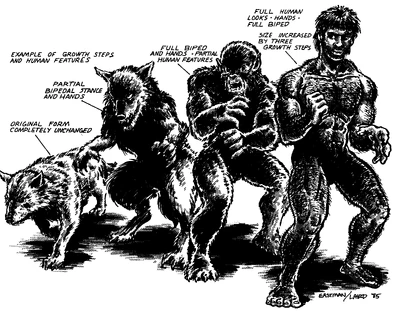
I think the one I'd like to see come back in some form or another is Teenage Mutant Ninja Turtles and Other Strangeness. I loved that setting, and after the D&D Red Box was my first real dive into RPGs. The core book had rules for making all sorts of mutant animals. Each animal had a set amount of "mutations" you could take; you might have animal features or a look that could pass as an ugly or exotic human. You might walk upright or hunched over. You may have paws, partial manual dexterity, or full human-like hands. You might be able to talk, you might not. You could also develop psionic powers. Maybe you kept your claws, or keen senses, or armored shell, or spines (the poking kind, not the skeletal kind). Each animal had a set number of "points" to spend on mutations, so you couldn't have everything. You had to give up some things for the sake of human-like stature.


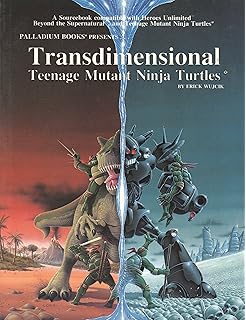
The supplemental books expanded on the core book, adding more animals and weird tech as seen in the TMNT comics; Triceratons, TCRI Aliens, space-faring adventures, even time- and dimensional-travel (along with mutant dinosaur heroes!). While the system was Palladium's core rules set, back then it wasn't as bloated as it got in later decades and was playable at that scale.

I'd love to see a revamp of that setting and a rules set that plays an homage to the original mutation rules, but obviously without the Palladium system. That could be a ton of fun. Someone should get on that.

...right.

*adds "TMNT" to the growing pile of Genesys Themes to write*

Adolescent Gene-spliced Martial Porcupines